For over a century, East Africa has held the undisputed title of the “Cradle of Mankind.” From the wind-swept shores of Lake Turkana in Kenya to the sun-baked depths of Olduvai Gorge in Tanzania, this region holds the world’s most spectacular, unbroken fossil map of our early ancestors.
But why here? Was East Africa simply an evolutionary paradise where our ancestors preferred to live, or is there a deeper, more violent geological secret at play?
The answer is a definitive yes—the Great Rift Valley has everything to do with this. The Rift did not merely act as a passive museum to preserve our ancestors’ bones; it was the active, chaotic crucible that drove them to evolve.
The Earth Slits Open: Nature’s Ultimate Time Capsule
To understand why East Africa yields the largest and most complete finds of hominids, we must look at the ground beneath our feet. In most places on Earth, the story of life is erased by time. Fossils are structural miracles; for an ancient skeleton to survive millions of years, it must be buried instantly, shielded from scavengers, and protected from the crushing weight of the earth.
The Great Rift Valley—a massive scar slicing across the continent where tectonic plates are tearing Africa apart—became the ultimate fossil-making factory through a sequence of natural engineering:
- The Sinking Vault: As the valley floor sank over millennia, heavy seasonal rains washed vast amounts of sediment down from the newly formed highlands. This rapidly blanketed dead organisms in thick layers of lakeside mud and river silt, sealing them away from oxygen and decay.
- The Volcanic Timestamp: The tearing of the earth sparked immense volcanic activity. Eruptions frequently blanketed the landscape in thick blankets of ash. This ash didn’t just preserve bones; it trapped radioactive elements, allowing modern scientists to use argon-argon dating to pinpoint the exact age of a fossil based on the volcanic layers sandwiching it.
- The Grand Unboxing: If these fossils had remained buried miles beneath the surface, humanity’s origin story would be lost forever. However, the continuous uplifting, faulting, and rapid river erosion in places like Olduvai Gorge and the Omo Valley have sliced open the earth like a layered cake. This exposes ancient, million-year-old soils directly to the open air, allowing paleontologists to literally walk along a dry riverbed and spot a hominid jawbone glittering in the sun.
The Great Rain Shadow: Driving Ancestors Out of the Trees
Beyond preserving our history, the Great Rift Valley was the environmental engine that forced our ancestors to change. Millions of years ago, equatorial Africa was a flat, uniform expanse of dense tropical rainforest. Our ape ancestors were perfectly adapted to a life spent entirely in the canopy.
Then, the earth fractured. As tectonic forces violently pushed up the mountains bordering the Rift, they created a massive rain shadow effect:
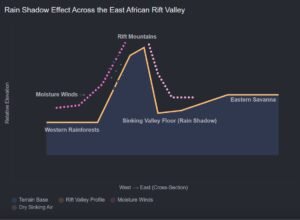
As the diagram shows, this barrier blocked moisture from the west. The lush jungles of East Africa dried out, fracturing into a mosaic of open woodlands and vast savanna grasslands.
Suddenly, our ancestors were forced out of the disappearing trees. To survive across the wide-open spaces between shrinking patches of forest, they had to adapt. Traveling long distances on the ground meant they needed to see over tall grass and keep their hands free to carry food or tools. This intense environmental pressure directly favored bipedalism—the revolutionary act of walking on two legs.
The Six-Million-Year Archive: Humanity’s Broken Silence
Because of this spectacular intersection of climate, geology, and preservation, East Africa boasts an unbroken chain of hominid data that spans nearly 6 million years, mapping our transition from ape-like creatures to modern humans:
| Species | Age (Approx.) | Famous East African Discovery Site | Key Evolutionary Milestone |
|---|---|---|---|
| Orrorin tugenensis | ~6.0 Million Years | Tugen Hills, Kenya | One of the earliest known hominids; femur indicates early upright walking. |
| Australopithecus afarensis | ~3.2 Million Years | Hadar, Ethiopia | Home to “Lucy”, providing the first complete look at early bipedalism. |
| Homo habilis | ~1.9 Million Years | Olduvai Gorge, Tanzania | The “Handy Man,” marking the first widespread use of stone tools. |
| Homo erectus | ~1.5 Million Years | Nariokotome, Lake Turkana, Kenya | Home to the “Turkana Boy“, the most complete early human skeleton ever found. |
| Homo sapiens | ~300K – 195K Years | Omo Kibish, Ethiopia | Some of the oldest anatomically modern human remains on the planet. |
Without the violent, tearing forces of the Great Rift Valley, the habitats that forced our ancestors to walk upright would never have existed—and the perfect geological vaults that preserved their bones would have remained locked forever. East Africa is not just where we find our history; it is the sacred theater where the human story truly began.
Step Into Your Own History
There is a profound difference between reading about human origins and standing where those origins took place. Imagine walking the desert shores of Lake Turkana where Turkana Boy took his first steps, or looking out over the immense depths of Olduvai Gorge where the echoes of ancient stone tools still seem to linger in the warm breeze. This is a journey back to the very dawn of our shared identity.
Would you like to be taken on an archaeological safari tracing the footsteps of the earliest humans? Let me know:
- Which primary sites you want to prioritize (e.g., the wild shores of Lake Turkana, the legendary Olduvai Gorge, or Olorgesailie)?
- Your preferred travel style (e.g., rugged expeditions, luxury lodge-based safaris, or museum-focused tours)?
- If you would like to pair this journey with traditional wildlife viewing in the Maasai Mara or Serengeti?
I can design the ultimate timeline itinerary to guide you home.